FIELD NOTES / BIOLOGY MEETS SOFTWARE
A fly brain.
An internet-sized afterlife.
We mapped a fruit fly’s wiring. Then the internet gave it Minecraft, Doom, and lightsabers. This page gives it somewhere to wander.
MEET THE RESIDENT
A little brain. A new backyard.
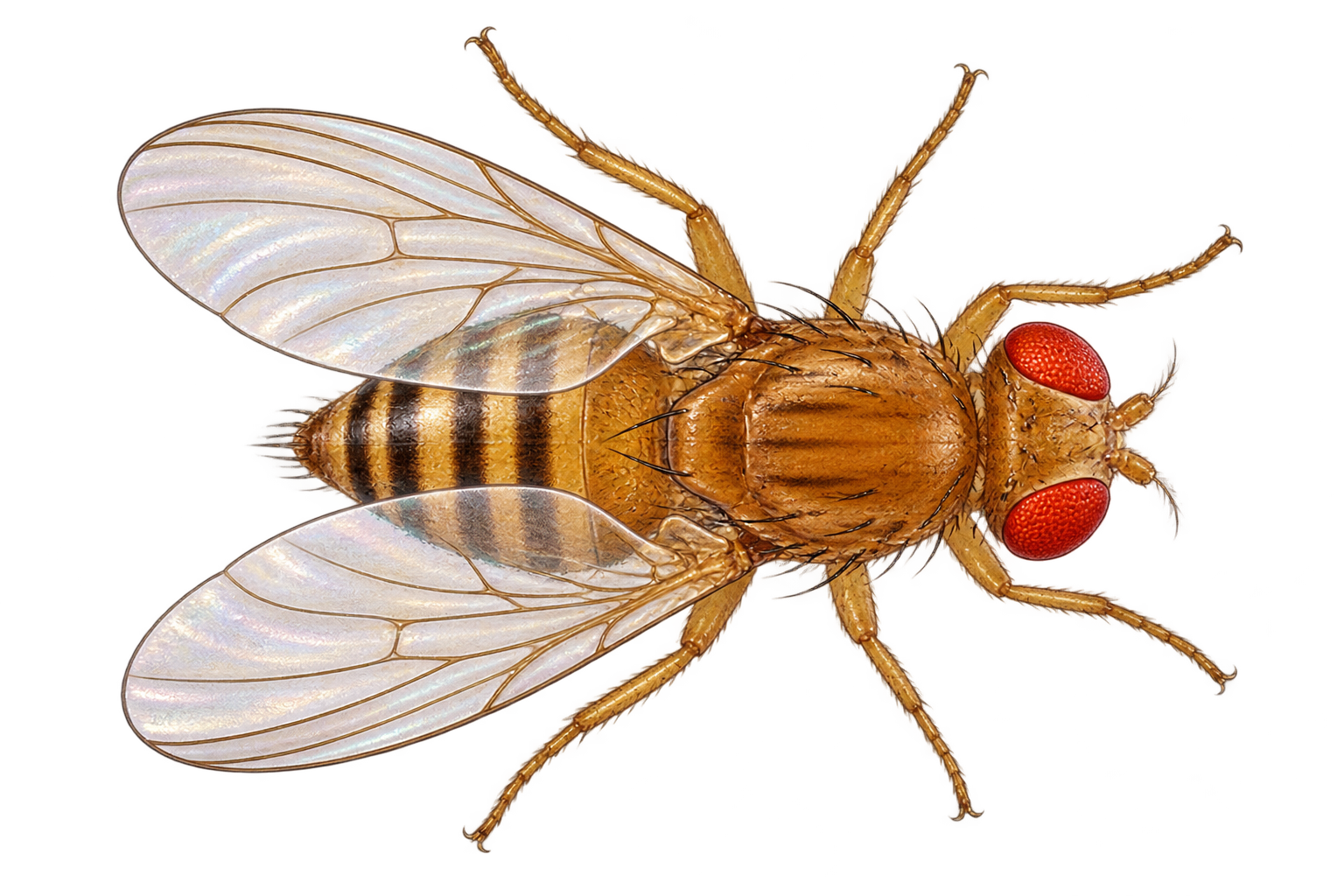
Loads 23 MB of real connectome data. Runs on your device while this page is open.
What’s driving the fly?
The published connections run through a simplified spiking-neuron model. Real simulated output rates influence turning, speed, feeding, grooming, and escape. An added page controller supplies flight, curiosity, and block building. Those added rules make this a playful experiment, not a validated digital animal.
Simulation paused. Rates are measured in simulated time. Brain time can run slower than the fly animation.
Data, assumptions, and credits ↓01 / THE BREAKTHROUGH
From a real insect to a wiring diagram.
A connectome records which neurons connect to which other neurons. Researchers reconstruct these tiny connections from electron-microscope images, using computational tools and extensive human proofreading.
On September 3, 2026, HHMI Janelia, Google Research, and collaborators announced a map of the adult male fruit fly’s central nervous system: over 166,000 neurons and 125 million synaptic connections, including the brain, visual system, and ventral nerve cord. It is an extraordinary amount of biological structure to make available for anyone to explore. Read the research announcement ↗
To run that structure, a programmer still has to choose how neurons fire, how simulated senses deliver input, and how activity becomes movement. A wiring map does not preserve every chemical state, memory, or detail of the original animal.
The wild part is that the starting point is a nervous system shaped by evolution. We can now ask it questions in software.
There is real science underneath the spectacle. In 2024, Shiu and colleagues built a fly connectome model that predicted responses in taste and grooming circuits, then tested many predictions in living flies. That is a stronger claim than simply getting a character to move on screen. Read the Nature paper ↗
02 / THE INTERNET EXPERIMENTS
New worlds, same astonishing starting point.
These are separate projects with different datasets, models, and control systems. A fly has not literally traveled from one game to another. Here is the source trail so far.
MINECRAFT / CONNECTOME + VIRTUAL BODY
A fruit fly in a block world.
Evan Sinclair Smith’s Neurocraft demo couples the MaleCNS graph to a Minecraft fly. Nearby entities, food, light, and touch provide input; selected neural outputs feed programmed movement routines. Its public page explicitly describes that division of labor.
Blendi Remade’s separate open-source Minecraft implementation includes a downloadable graph and models taste, looming, and grooming pathways. That compact graph is the basis of the resident on this page.
DOOM / EXPERIMENTAL GAME CONTROL
Of course someone gave it Doom.
Alex Wormuth’s DOOMFLY project connects game observations to a fly simulation and reads neural activity back as game controls. It experiments with reinforcement and plasticity. The project’s source and validation reports let you inspect the machinery; a running demo alone does not establish that the fly understands Doom.
BEAT SABER / CREATOR-REPORTED DEMO
The lightsaber chapter.
Lyra bubbles shared a fly-brain Beat Saber clip: the rhythm game with glowing sabers and incoming blocks. In a follow-up, the creator describes an early replay-fitted motor experiment, with visual responsiveness still being worked on. Treat it as a work in progress, rather than evidence of general game-playing skill.
SUPER MARIO 64 / EARLY CLIP
Another very strange controller.
Jessica Paquette’s September 7 post shows a fly-brain Mario 64 experiment. It belongs in the growing collection of playful attempts to connect biological wiring to new virtual bodies. The clip is a demonstration, not a benchmark of competence.
SIMULATED FLY BODY / EMBODIMENT
Before the game crossovers.
Eon Systems’ March 2026 demonstration connected a fly brain model to a simulated fly body. This is a separate line of work involving the female connectome and a movement controller. It helps explain the idea of embodiment: a network receiving sensations and acting through a body.
Still tracing: GTA and a literal fruit-slicing game. I have not verified an original creator source for those clips. The sourced lightsaber demo above is Beat Saber. This record was checked on September 9, 2026.
03 / OUR RESIDENT
So I gave it a corner of the wiki.
Release the fly at the top of this page. It can wander while you read, find fruit, react to a startle, and return to its block patch. Turn off Roam the page to keep it in the backyard. Pause it any time, or press Escape.
The lights in the wiring view are sampled spikes from the running network. Offer fruit places a food target; getting close stimulates sugar-sensing neurons. Brush antennae and Startle stimulate mapped sensory populations directly. Open the readings to see the resulting output rates.
The block building is an extra creative layer I wrote for this page. Its controller alternates exploring, collecting, and placing blocks, with a little randomness in the structure. It is not a biological claim that flies plan architecture. The patch persists in this browser; neural activity starts fresh when you reload.
Notes from the backyard
Blocks are saved on this device.
- Waiting for the resident to arrive.
There is something delightful about giving a piece of this research a tiny, ordinary place to be. A wiki page seems like as good a backyard as any.
04 / OPEN THE HOOD
What this replica includes.
This page runs 176,422 graph nodes and 6,287,749 directed connections from a MaleCNS v1.0 derivative. The compiler retains connections with at least five synapses, representing 90,296,905 synapses. Its node count includes unclassified entries, so it differs from the curated headline count. It is not the complete unfiltered research graph.
Each node uses a simplified leaky integrate-and-fire model. We use a 0.2 ms integration step, fixed delays, predicted neurotransmitter signs, a global weight scale, and reduced input gain for Kenyon cells. These are modeling assumptions, not a measurement of this fly’s full physiology. There is no language model, online learning, or claim of consciousness here.
The neural simulation runs in a browser worker after you release the fly. It pauses when this tab is hidden. Closing the page stops it; only the block patch is saved. The illustrated body and movement animation are separate from the wiring data.
- MaleCNS data · HHMI Janelia and collaborators — CC BY 4.0. Graph compilation and filtering by Blendi Remade / fal.ai.
- Pinned upstream implementation — MIT code. This page adapts the model and sensory mappings into JavaScript.
- Data license · Code license · Implementation notes and reproduction steps
Independent educational experiment. The original researchers and demo creators have not endorsed this page.